
Recent Student Posts

About Student Insights
Student Insights is a supportive space where learners craft assignments, share visuals, and receive constructive feedback to improve writing, organization, and critical thinking.
Join Our Newsletter
Receive tips on essay structure, visual storytelling, and editing tricks straight to your inbox to help you excel in every course.

NAEYC: Championing Early Childhood Advocacy
Advocacy in early childhood education is about ensuring that every child has access to high-quality learning opportunities. Yet, access remains uneven, with many families struggling to afford or find programs that meet their needs (NAEYC, 2024). Early childhood education advocacy also supports educators in their quest for fair compensation and recognition. The NAEYC, is a powerful advocate for both educators and children (Kang, 2023). By addressing issues of compensation, equity, and access, the organization inspires change that strengthens families and communities.
The History of the NAEYC
The NAEYC was founded in 1926 and has grown into the largest professional organization dedicated to early childhood education. Today, it represents nearly 60,000 members and more than 50 affiliated organizations across the United States, creating a nationwide network of advocacy and professional support (NAEYC, 2025). Through its accreditation system, NAEYC reaches close to one million children each year by ensuring that early learning programs meet consistent standards of quality. The association has accredited nearly 7,000 programs nationwide, including preschools, child care centers, and school-based programs (NAEYC, 2025). Its mission is ‘to promote high-quality early learning for all children, from birth through age 8, by connecting practice, policy, and research.’ Its vision is ‘that all young children thrive and learn in a society dedicated to ensuring they reach their full potential’ (NAEYC, 2020). From its inception, NAEYC has been a leader in setting professional standards, advancing research-based practices, and advocating for policies that expand access to quality early learning.
NAEYC’s Achievements through the Years
Over the past century, NAEYC has marked a series of milestones that have shaped the field of early childhood education. Founded in 1926 as the National Association for Nursery Education (NANE), the organization broadened its scope in the 1950s when it was renamed the National Association for the Education of Young Children, signaling a commitment to children beyond nursery age.
During the War on Poverty in 1965, NAEYC played a pivotal role in advocating for programs that led to the launch of Head Start. Just a few years later, in 1971, it established the Week of the Young Child, a tradition that continues to raise awareness of the importance of early learning.
The 1980s brought two landmark achievements: the launch of the National Voluntary Accreditation System in 1985 and the publication of the Developmentally Appropriate Practice statement in 1987, both of which set professional standards that continue to guide educators today.
In the 2000s, NAEYC expanded its policy advocacy, amplifying its voice in national debates about child care and education. More recently, in 2020, the organization updated its Developmentally Appropriate Practice statement to reflect evolving research and practice.
NAEYC’s centennial era has been marked by bold advocacy. In 2024, it released the Compensation Means More Than Wages report, underscoring the need for comprehensive benefits alongside fair pay. And in 2025, the organization highlighted workforce challenges and children’s access issues in its Public Policy Forum, reinforcing its role as a leading voice for equity in early childhood education.
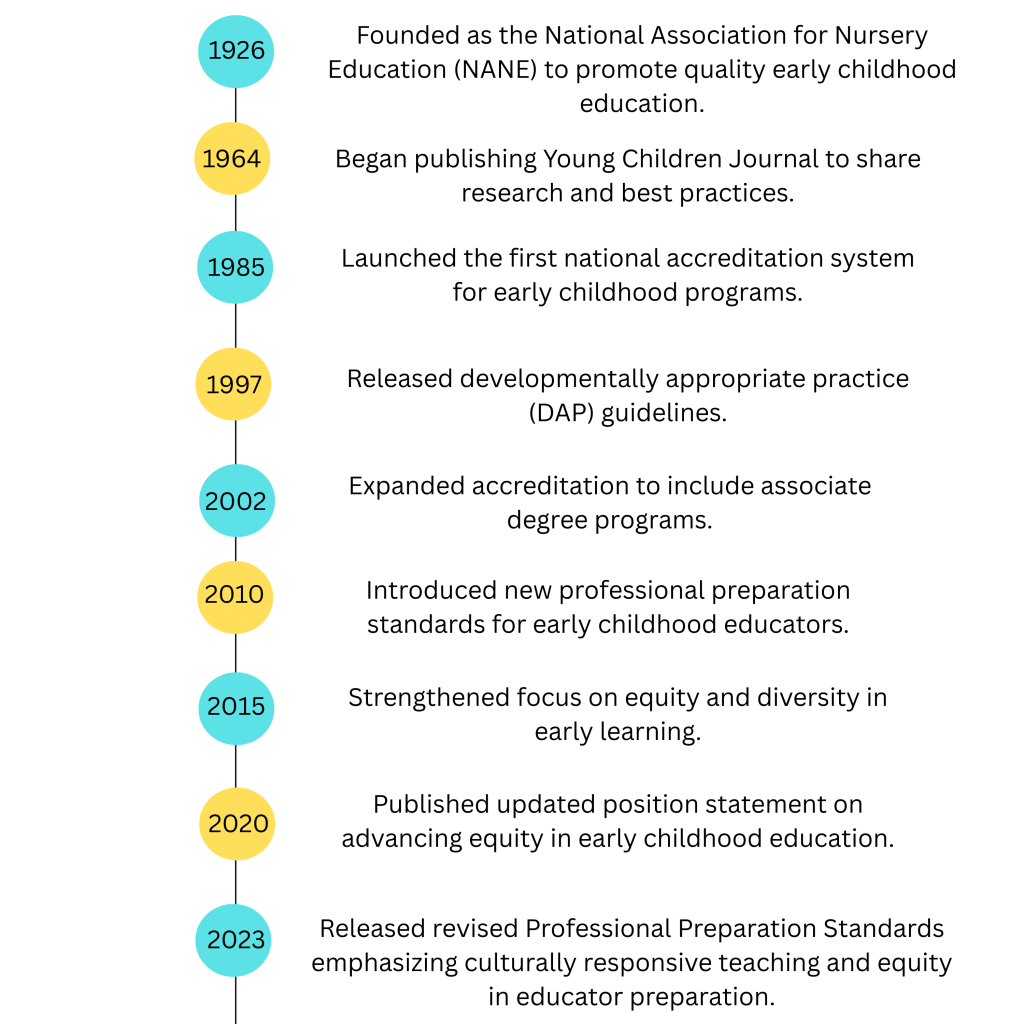
Timeline of NAEYC’s Key Achievements
Leadership Spotlight: Michelle Kang
Michelle Kang became NAEYC’s CEO in 2022, bringing with her a vision centered on equity, inclusion, and advocacy for both children and educators (NAEYC, 2025). She often describes early childhood educators as “the workforce behind the workforce” (Kang, 2023), emphasizing their critical role in supporting families and communities. Kang’s leadership has been marked by efforts to expand access for families, particularly those in underserved communities, while ensuring that educators are supported to deliver excellence.
Early childhood educators are the workforce behind the workforce. Michelle Kang
Contributions to Advocacy
NAEYC’s contributions extend beyond the workforce to children’s direct access to education. The organization has consistently advocated for increased federal and state funding to make early childhood programs affordable and available to all families (NAEYC, 2024). It has championed initiatives that expand access to preschool, improve child care quality, and ensure inclusive practices for children with disabilities.
Recent initiatives, such as the report Compensation Means More Than Wages (NAEYC, 2024), highlight the need for comprehensive benefits alongside fair salaries. These efforts underscore the reality that educators cannot provide quality care if they themselves are struggling to make ends meet.
Challenges Faced
Despite these achievements, challenges remain. Access to affordable, high-quality early childhood programs is still limited for many families, particularly those in rural areas or low-income communities (NAEYC, 2024). The expiration of pandemic relief funds has led to program closures, reducing options for families. Public perception also undervalues early childhood education compared to K–12, making it harder to secure consistent policy support. Kang and NAEYC frame these challenges as opportunities to strengthen advocacy and build coalitions that prioritize children’s needs alongside those of educators.
Impact on Educators, Children, and Families
The impact of NAEYC’s advocacy is twofold: it empowers educators and expands opportunities for children. By raising professional standards and pushing for equitable compensation, NAEYC ensures that teachers can provide stable, high-quality care (NAEYC, 2025). At the same time, its advocacy for funding and access helps families afford programs and ensures children benefit from inclusive, developmentally appropriate learning environments (NAEYC, 2020). Communities gain as well, since strong early childhood systems contribute to economic stability and long-term success.

The Future of NAEYC
As NAEYC moves forward, the organization has expressed its intention to collaborate with peer associations internationally, extending its advocacy beyond the United States (NAEYC, 2025). These partnerships will create opportunities to exchange culturally responsive practices, broaden advocacy efforts, and position NAEYC as a leader in shaping global standards for equity and access. By expanding its reach, NAEYC aims to amplify its mission and contribute to a more unified worldwide effort to ensure that all children benefit from high-quality early learning opportunities.
Conclusion
Across its century of work, NAEYC has consistently advanced the cause of early childhood education by raising professional standards, advocating for equitable compensation, and expanding access for families. Its history reflects both resilience and innovation, from the establishment of accreditation systems to the leadership of Michelle Kang, who continues to frame educators as the ‘workforce behind the workforce.’ Challenges remain, including uneven access and undervaluation of the field. However, NAEYC’s ongoing advocacy shows that progress is possible when educators, families, and policymakers unite around a shared vision. Taken together, the organization’s past achievements and future commitments highlight its enduring role as a catalyst for equity and excellence in early learning.
References
Swartz, M. (2023, October 31). NAEYC’s Michelle Kang: Empowering “the workforce behind the workforce.” Early Learning Nation. https://earlylearningnation.com/2023/10/naeycs-michelle-kang-empowering-the-workforce-behind-the-workforce
National Association for the Education of Young Children. (2020). Developmentally appropriate practice position statement. National Association for the Education of Young Children.
National Association for the Education of Young Children. (2024). Compensation means more than wages. National Association for the Education of Young Children.
National Association for the Education of Young Children. (2024). We are not OK: Workforce survey. National Association for the Education of Young Children.
National Association for the Education of Young Children. (2025). Public policy forum highlights. National Association for the Education of Young Children.
 Student Insights